


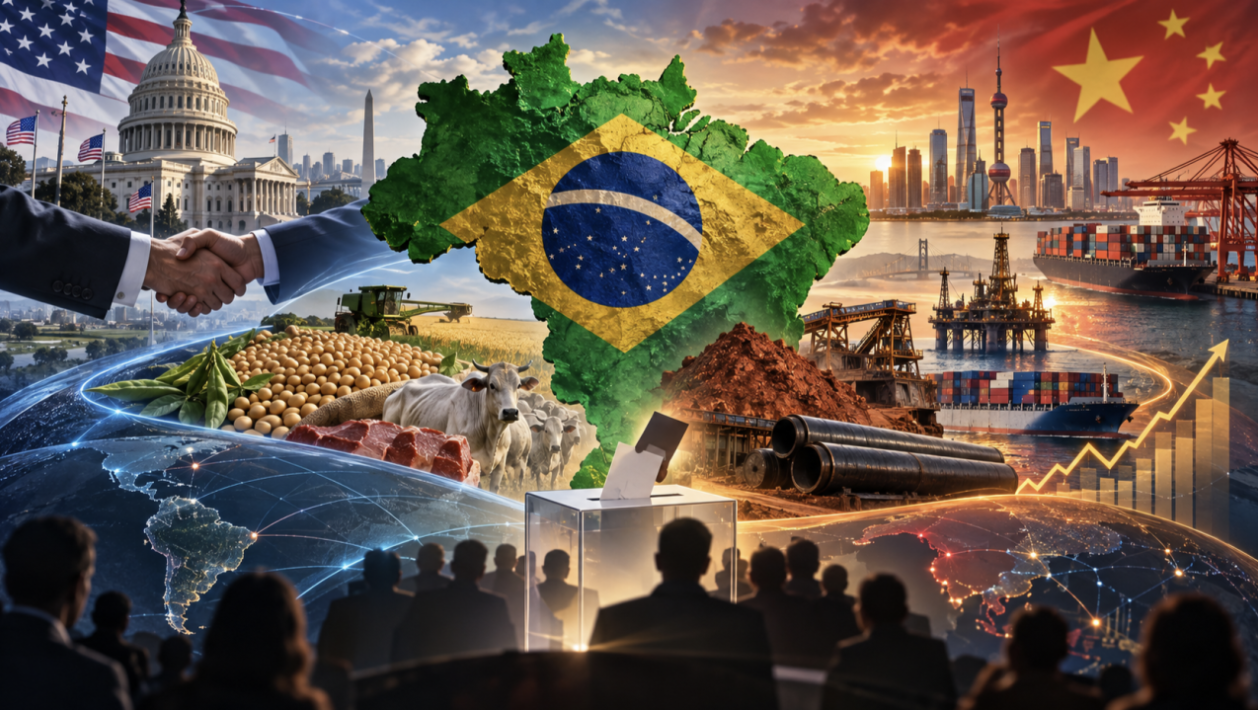

Brazil Between Washington and Beijing: A New Balance of Power
The first round of the Brazilian presidential election may have started a new chapter. Flávio Bolsonaro led with 47.03% of the vote, ahead of Lula with 45.16%. Nothing is decided before the second round on October 25. But if Flávio Bolsonaro wins, an important question will arise: Can Brazil move closer to the United States while staying closely connected to China?
For now, this is just a possibility. If Flávio Bolsonaro wins, it does not mean Brazil will suddenly turn toward Washington. But it lets us imagine how the balance between the U.S. and China might change. Flávio Bolsonaro comes from a political family with long-standing ties to Donald Trump and his team. This connection was clear during the campaign. If he becomes president, Washington could find more political influence in Brazil, which Lula had tried to balance by making Brazil’s diplomacy more independent and open to both the BRICS group and China. It may seem that the United States will gain ground and China will lose some. This might be true in some areas. But the reality is more complex.
China is no longer just another partner. It is now essential to Brazil’s economy. China is Brazil’s top trading partner and a major market for its raw materials. Soybeans, iron ore, oil, and meat: a large share of Brazil’s exports depends on Chinese demand. In agriculture, China accounted for more than 35% of Brazil’s exports in the first half of 2026, while the U.S. accounted for less than 6%. China is also Brazil’s main supplier. This is Bolsonaro’s real challenge. A president can quickly change the tone and priorities of foreign policy. He can get closer to Washington, increase cooperation with the U.S., or be less enthusiastic about BRICS. He can also be more careful about some Chinese investments in sensitive areas. But he cannot easily change the facts of Brazilian trade. A soybean farmer in Mato Grosso will not stop selling to China just because his president is close to Donald Trump. A mining company will not give up an important client for ideological reasons. And the Brazilian government cannot ignore the political and economic weight of its farming sector.
That’s why a break between Brasília and Beijing seems unlikely, even if Flávio Bolsonaro wins. The most likely scenario is a new balance: a Brazil politically closer to the U.S., but still closely connected to China economically. For China, the risk is different. China may keep buying Brazilian soy, iron, or oil, but could lose some of the political and strategic influence it has gained in recent years. Infrastructure, telecommunications, technology, critical minerals, energy, and big investments could become much more competitive areas between Washington and Beijing. The BRICS group will also be important. Lula used BRICS to increase Brazil’s independence and push for a multipolar world. Bolsonaro might keep Brazil in the group but give it less political importance or distance Brazil from some positions supported by China. Weakening BRICS’s political side would already be a win for Washington.
But the U.S. also has a weakness. Trump wants to bring Brazil closer to Washington while using tariffs to defend American interests. But these pressures have already pushed Brazilian companies to look for other markets, making China even more attractive. Washington can win politically but push Brazil further toward China in trade. That may be the real challenge of the second round. Brazil doesn’t have to choose between the U.S. and China. In fact, it benefits from delaying that choice as long as possible. The real question is how close a Bolsonaro government can get to Washington without harming its relationship with Beijing.
Flávio Bolsonaro seems to understand this limit, since he has already supported a pragmatic economic relationship with China. This makes sense. Being close to Trump does not mean Brazil can ignore the Chinese market. China knows this, and so do Brazilian business leaders. Both powers have very different strengths. The U.S. can rely on political, strategic, and ideological closeness with Bolsonaro. China has the power of its market, trade, and investments. Washington can offer political ties. Beijing can remind Brazil of the cost of worsening economic ties.
The markets’ reaction after the first round is interesting. The Brazilian real gained value and the Brazilian stock market jumped. Investors mostly expect a more market-friendly policy if Bolsonaro wins. They don’t see a crisis with China as the main risk. That could change if China becomes a source of conflict. The U.S.-China rivalry is now part of Brazilian politics, but not as a simple choice between Washington and Beijing. It is a contest between American political power and Chinese economic power.
A win for Flávio Bolsonaro could be a political victory for Washington without being an economic defeat for Beijing. It all depends on how the new government manages its relationships. Brazil could end up like many other middle powers: in the U.S.-China rivalry, it can get politically closer to one side, but it’s much harder to break economic ties with the other.


