

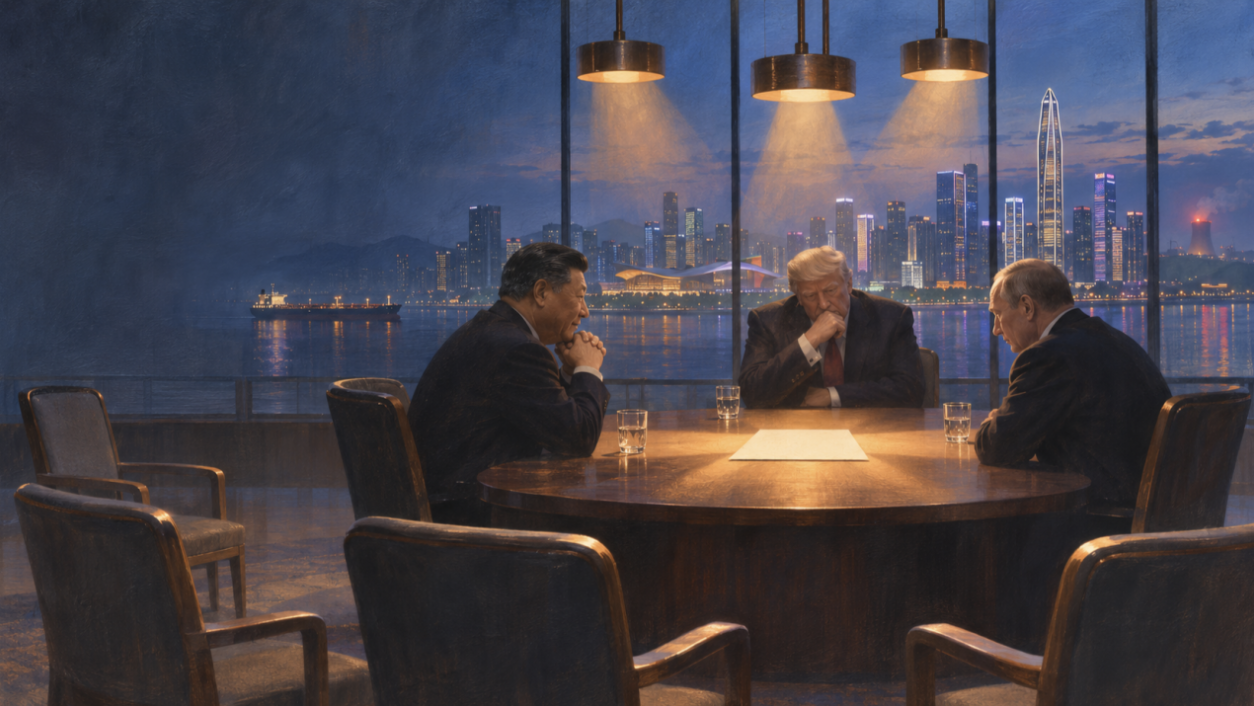

Three superpowers gathered at a table in Shenzhen, but at what cost to peac
In Shenzhen on November 19, Vladimir Putin, Donald Trump, and Xi Jinping released a “declaration toward peace.” From the announcement of a momentous deal to the criticism of a straightforward photo, reactions vary widely. But instead of demonstrating how much they are willing to alter their ideas, the three leaders mostly came up with things to talk about together. (1)
The statement has four points. It insists on state officials’ immunity before international tribunals, pledges to work on a UN reform, proposes a dialogue on nuclear risks and proliferation, and plans to boost the production and delivery of refined petroleum products.
There is no indication of fuel volume, a negotiating date, or a request to reduce arsenals. It does not mention Taiwan, Iran, or Ukraine. (1)
This absence does not mean these crises have gone unnoticed. According to the Chinese source, the presidents spoke about the Korean Peninsula, the Middle East, and Ukraine. (2)
However, discussing a war and reaching a consensus on how to end it are two distinct processes. It is also essential to distinguish between the outcomes of the three-way summit and those of individual leader sessions.
So what is the significance of this meeting? These three nations have nuclear weapons and can simultaneously affect several situations. They have an interest in preventing an incident or a poor decision from worsening, even if they disagree on everything else.
Therefore, the commitment to talk about nuclear threats is valuable. It will be considered a durable advancement only if it results in designated interlocutors, frequent meetings, and crisis communication channels. In its summit presentation, Beijing suggested such procedures, but the joint communiqué does not specify any. (1)
The second thing to note is energy. The leaders discuss refined products like petrol and diesel as well as flow stability. Fuel supply and cost are at issue.
However, the language does not say who will boost their deliveries or how quickly. Neither penalties nor an agreement on the Strait of Hormuz are included. The outcome would be a measurable increase in supply; intention alone does not currently permit measurement. (1)
International justice is arguably the most political section. The three leaders give special weight to official immunity and governmental consent. The International Criminal Court’s arrest order for Vladimir Putin directly aligns with Moscow’s stance.
Washington’s hostility to the Court’s use of some of its powers reflects this. There, Beijing finds a way to protect state sovereignty. (3) The Rome Statute states that the head of state’s position is insufficient to bar the Court from exercising its jurisdiction, so this is a diplomatic convergence rather than a legal shift. (4)
The same care must be taken when referring to a UN reform. What should be changed? The Security Council’s makeup, the veto, or its procedures? It is not made clear in the text.
The other two permanent members, France and the United Kingdom, as well as a sizable majority of the member states, must concur for the three nations to change the Charter. (5) Their approach can lead to productive work or exacerbate concerns that other nations are being consulted too late.
As a result, each one departs with a distinct advantage. Xi Jinping positioned China at the heart of the gathering and also showed that China could host its two main interlocutors at the same time.
Without securing an agreement on Ukraine or the easing of sanctions, Putin returned to the international stage with a major position and a consensus formulation favoring immunity. Trump initiated a dialogue on energy and nuclear matters, but he did not announce a decrease in weapons or a compromise on Iran.
These increases in visibility do not yet amount to a strategic win.
A number of things could happen. The most likely option, which calls for minimal compromises, would be risk management, in which the three nations maintain their opposition to one another while establishing avenues to prevent an uncontrollable conflict.
Another might be a number of small agreements, such as specific fuel delivery, organized nuclear talks, or spontaneous crisis assistance. Even without a significant peace deal, these results would matter.
More worrisome is a third theory: leaders may try to settle disagreements among themselves by excluding the affected nations. The summit does not establish whether such a division of influence exists. It raises the question, particularly with regard to Ukraine.
European officials were cautioned in Berlin that a peace decided above their heads would not be acceptable. (6) Shenzhen could facilitate more robust negotiations if the next talks genuinely involve the relevant states. Lastly, the discrepancies can reappear, leaving the statement unaddressed.
Shenzhen will thus be evaluated based on three straightforward criteria. Will the nuclear dialogue have a set date and time? Will the extra gasoline be supplied and quantified? Will the nations whose security is at risk take part in the decisions that affect them?
It was evident at the meeting that the three leaders are open to communication. Its extent will be determined by what they decide to accomplish and how much control they give others over their own destiny.
Source:
- Joint declaration by the three heads of state, White House, November 19, 2026; the text was also published by the Chinese government.
- Chinese Ministry of Foreign Affairs, account of the trilateral summit, November 19, 2026; see also its account of the Xi–Trump meeting.
- International Criminal Court, announcement of the arrest warrant for Vladimir Putin, March 17, 2023; White House executive order imposing sanctions on the Court, February 6, 2025. China’s position on state sovereignty appears in the account cited in note 2.
- Rome Statute of the International Criminal Court, Article 27. The op-ed distinguishes the political position expressed at the summit from the rules currently governing the Court.
- Charter of the United Nations, Article 108, on the amendment procedure. The five permanent members of the Security Council are China, France, Russia, the United Kingdom and the United States.
- Reuters, report on the summit and reactions in Berlin, November 19, 2026.


