


France on the World Stage, Divided at Hom
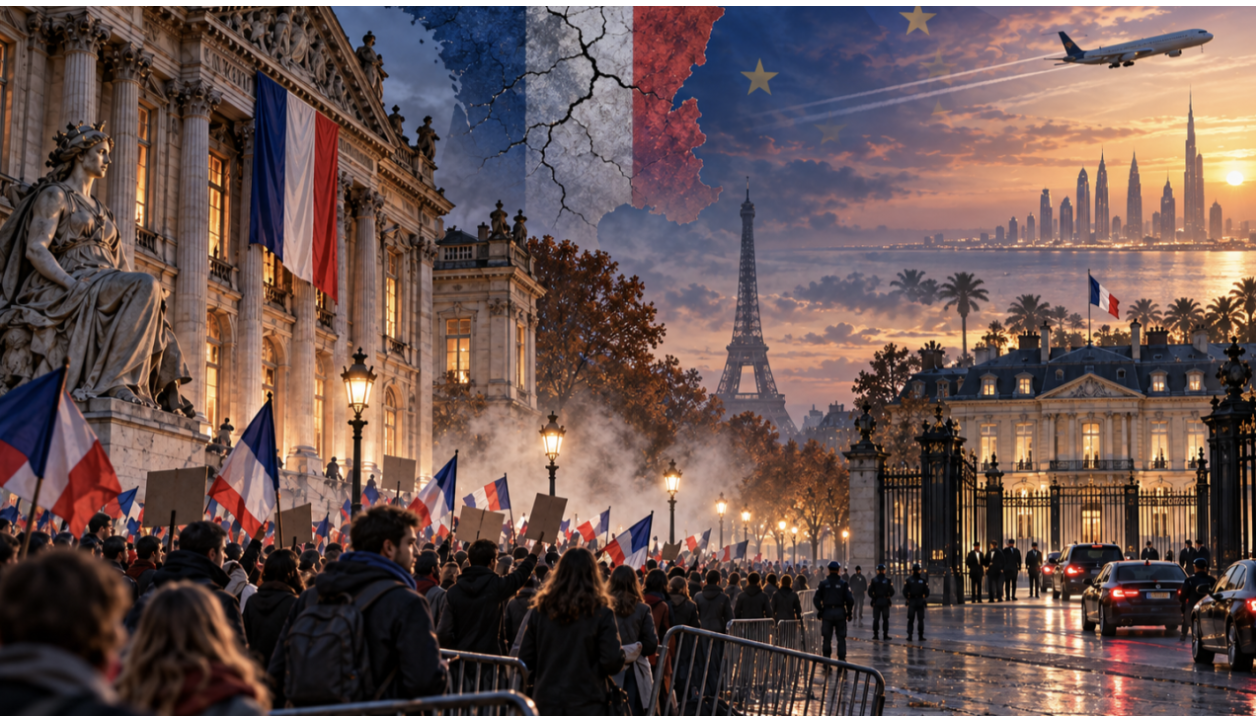
The riots of October 17, 2026, in France are not just a public order crisis. They raise a more important political, sociological, and geopolitical question: how can a country that wants to defend international stability and European sovereignty retain its influence when its internal cohesion is fractured?
The protests, which initially began with demands for purchasing power, education, and public services, brought together several hundred thousand people. They were accompanied by violence, looting, and attacks on public buildings.
Beyond the clashes, the relationship between a part of French society and its institutions deserves analysis. When a town hall, a symbol of the Republic, becomes a target of violence, it takes on an additional dimension. It raises questions about respect for authority and the trust placed in those who embody it.
At this point, the domestic crisis becomes geopolitical.
Since arriving at the Élysée, President Emmanuel Macron has defended the idea of a France capable of influencing major international balances. Whether it is about Ukraine, the Middle East, European defense, or relations between great powers, he seeks to keep diplomatic initiative. But the violence of October 17 comes as the president pursues this ambition, notably through his trip to the Gulf countries to discuss regional security and energy supplies.
Can this be seen as a contradiction between a president preoccupied with world affairs and a country facing its own difficulties? Two readings are possible.
The first highlights the risk of a mismatch between the president’s priorities and the expectations of a population for its purchasing power and its security.
The second recalls that energy diplomacy can help reduce French economic difficulties. Tensions over oil, Middle East conflicts, and rising energy costs directly affect citizens’ daily lives.
But the most revealing fact of this crisis is in international reactions.
In the United States, Donald Trump comments on the French unrest by linking it to migration and the supposed difficulties of the European model. On the Russian side, media outlets and people close to the Kremlin saw the violence as a sign of Western decline, calling into question European energy choices and sanctions against Moscow.
This rapprochement of discourses is geopolitically significant. Washington and Moscow pursue often divergent interests, but some of their leaders see France’s difficulties as an opportunity to feed a shared narrative about Europe’s fragilities. This is not necessarily a coordinated action, but rather a convergence of interpretations that are politically useful to everyone.
In Europe, people interpreted events differently. Some political leaders see this as confirmation of their criticisms regarding immigration and public authority. These divergences illustrate a key phenomenon: a national crisis quickly becomes an object of international ideological confrontation.
A State’s power rests not solely on its military means, economic capacity, or diplomatic status. It also depends on the stability of its institutions, social cohesion and the trust that it inspires in its partners. The disturbances of October 17 do not take away from France its nuclear arsenal, its permanent seat on the United Nations Security Council, or its central role in the construction of Europe. But prolonged instability could reduce its policy space.
Another indicator is financial markets. Rising financing costs for French debt and tensions in the stock market show how political uncertainty can add to pre-existing economic concerns.
At the European level, a France overwhelmed by its internal difficulties could face more obstacles to overcome in terms of defense, strategic sovereignty or common foreign policy.
One important question remains: is France experiencing a temporary crisis of public order, or a deeper shift in the relationship between those who govern and those they govern?
Three scenarios are conceivable: appeasement made possible by dialogue and concrete responses;
a stagnation of social and political tensions;
a tightening of security that could open up a new debate on public freedoms.
The October 17 crisis raises a broader question than Emmanuel Macron’s political future. It asks whether France can reconcile its international ambitions, its economic constraints, and the expectations of its population.
A democracy can withstand massive demonstrations without losing legitimacy, but what weakens the State is its inability to distinguish between legitimate demands for violence, to guarantee security without compromising freedoms, and to turn social conflicts into political compromises.
France remains an international power. But its future credibility will depend on whether it can restore trust between its institutions and citizens.
The question is: can France still be heard abroad if it fails to renew dialogue with itself?


