


Israel’s 2026 Elections and Their Impact on the Future of the Middle East and the Kurdish Nation
By Arif Bawecani
Some elections only concern the internal fate of a single country. Others, however, due to the nation’s geographic, political, and strategic significance, exert a broad influence on the region and even on international politics. The Israeli Knesset election in 2026 is one such election.
Since its establishment, Israel has been one of the central political and security hubs of conflict and struggle in the Middle East. Its relations with Palestine, Lebanon, Iran, and regional forces allied with Iran mean that political changes within Israel are closely monitored by regional states and the international community.
At the same time, the Knesset election is not merely a domestic matter; the composition of the Knesset and political coalitions can influence the direction of Israeli policy, international relations, regional security, and the approach to key issues in the Middle East.
The Knesset Electoral System
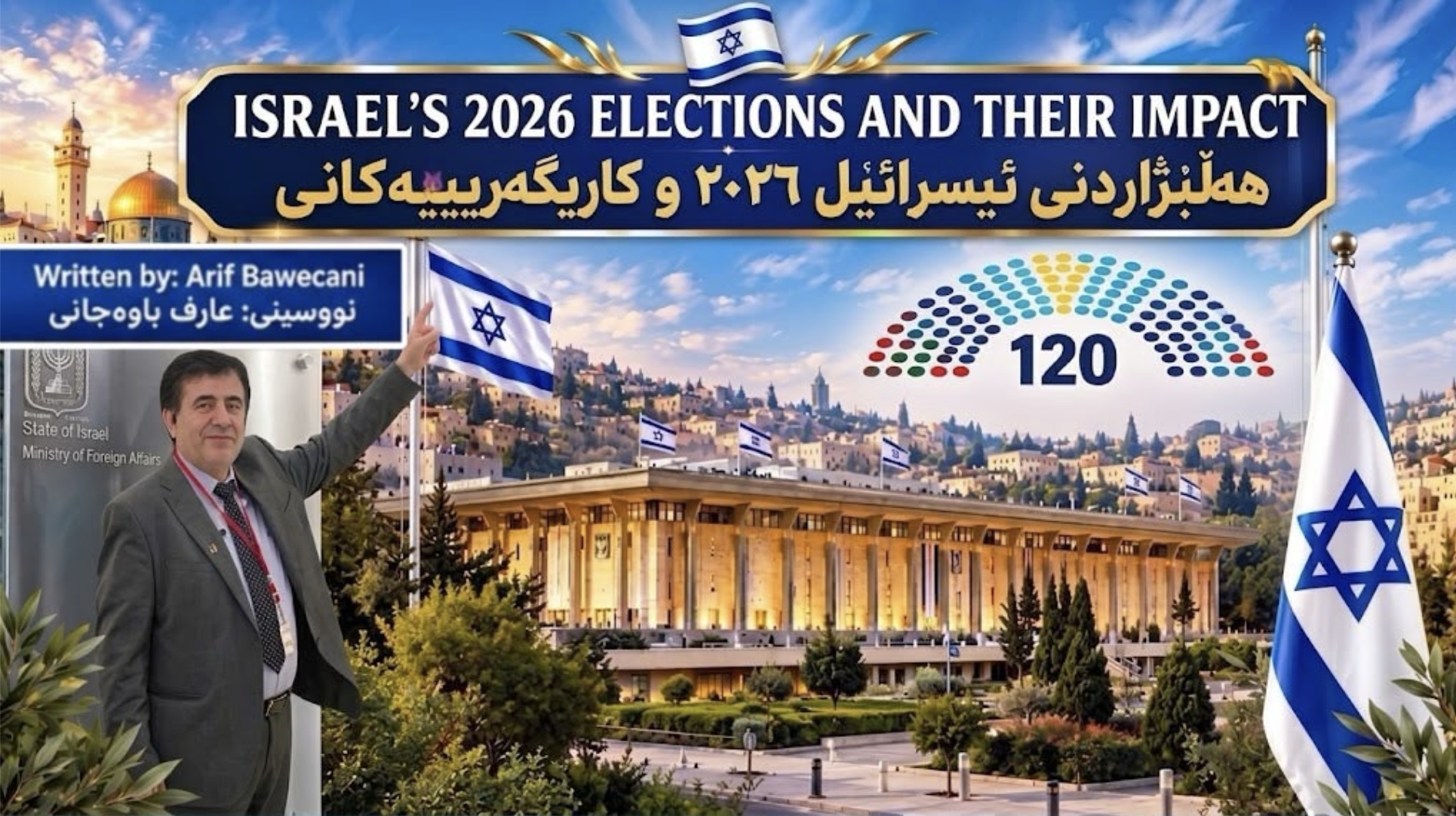
The Israeli Knesset consists of 120 members elected through a nationwide, direct, secret, and proportional representation system via political party lists. The standard term of the Knesset is four years, though it can be dissolved early under certain circumstances.
The election for the 26th Knesset will take place on October 27, 2026.
In the Israeli political system, the composition of the Knesset and the ability of parties to form a parliamentary coalition play a critical role in forming the government and shaping the country’s policy directions.
Major Parties and Lists in the 2026 Election
1. Likud
Likud is one of the main parties in Israeli politics, founded in 1973. Under the leadership of Menachem Begin, the party first came to power in 1977 and subsequently became a dominant political force. Led by Prime Minister Benjamin Netanyahu from 2009 to the present, it has consistently remained a primary victor.
2. Together (Beyachad)
Together is a joint list formed for the 2026 election, incorporating Bennett 2026 (led by Naftali Bennett) and Yesh Atid (led by Yair Lapid). The partnership was announced in April 2026. This list presents its own program and vision regarding security, the economy, governance, and foreign relations.
3. Yashar! (Straight!)
Yashar! is a party led by Gadi Eisenkot, former Chief of General Staff of the Israel Defense Forces. Among the most critical items on its agenda are safeguarding national security, strengthening Israel as a regional power, fostering relations and cooperation with regional countries, and reforming state institutions.
4. The Democrats
The Democrats was formed in 2024 through the merger of the Labor Party and Meretz, operating under the leadership of Yair Golan. Identifying itself as a Zionist, liberal, and democratic party, its agenda emphasizes democracy, the rule of law, democratic institutions, and socio-economic issues.
5. Shas
Founded in 1984, Shas is a Sephardic Ultra-Orthodox party. Throughout its political activity, it has become one of Israel’s influential parties, participating in governing coalitions across various periods.
6. Yisrael Beiteinu
Founded by Avigdor Lieberman in 1999, this party initially drew strong support from former Soviet Union immigrants as well as secular and right-leaning voters. Security, military service, and Palestinian relations form core elements of its agenda.
7. Otzma Yehudit (Jewish Power)
Otzma Yehudit is a far-right, national-religious party. Itamar Ben-Gvir is one of its prominent figures. The party holds a right-wing stance on issues of land, Israeli sovereignty, and the Palestinian question.
8. United Torah Judaism
Formed in 1992 through the merger of two religious parties, its primary focus centers on protecting the interests of the Haredi (Orthodox) community and religious-social matters.
9. Religious Zionist Party
Positioned on the far right of Israeli politics, its agenda focuses on strengthening Jewish identity, religious education, and national policy. Bezalel Smotrich leads the party and has held ministerial posts in previous governments.
10. The Joint List
The Joint List was established in 2015 when several Arab parties and Hadash united on a single electoral slate. While successful in past elections, its internal structure later changed due to disagreements. Therefore, its historical composition should not be confused with the structure of the 2026 election.
11. United Arab List (Ra’am)
Ra’am is an Israeli Arab party founded in 1996. In the 2021 election, it officially joined the Bennett-Lapid governing coalition—marking the first time an Arab party officially became part of a ruling government. Ra’am supports the establishment of a Palestinian state and advocates for the rights of the Arab community in Israel.
12. Amcha Yisrael (Our Nation Israel)
Amcha Yisrael is a new party formed ahead of the 2026 election, led by Ofer Winter. Its platform encompasses issues regarding security, Gaza, a Palestinian state, judicial reform, and Haredi military service.
13. The Reservists
The Reservists is a new party led by former Israeli minister Yoaz Hendel. Established in 2025, the party emphasizes Zionist values, national defense, military or national service for citizens, and strengthening national unity.
Iran and Israeli Policy
One of the most critical topics in the 2026 election is Israel’s relationship with Iran and the future of Israeli security policy toward the Islamic Republic of Iran.
In 2025 and 2026, the Iran issue prominently entered strategic discussions involving Israel, the United States, and regional nations. In its assessments, Chatham House highlights external pressure, Iran’s security situation, and the impact of the Iran-Israel conflict on Iran’s political and strategic future.
Consequently, any major shift in Israeli policy toward Iran could affect the regional balance of power. However, this relationship should not be understood in simple, linear terms. Israeli policy toward Iran is not determined solely by election results, but depends on the government, the Knesset, security and military forces, relations with the United States, and broader regional developments.
Eastern Kurdistan and Non-Persian Nations: Opportunities and Risks
In the region’s evolving environment, the issue of non-Persian nations in Iran—including Kurds, Arabs, and Baluchis—could feature more prominently in future discussions about Iran.
Specifically, the issue of the Kurds in Eastern Kurdistan (Rojhelat) could be introduced into political dialogue during any strategic shift in Iran. This presents an opportunity to bring national and political rights issues before the international community.
However, opportunities carry inherent risks. If the Kurdish issue is treated merely as a military tool or a strategic leverage point against the Iranian regime, Kurdish political and national demands risk being overshadowed by security and military imperatives.
The same dynamic applies to other non-Persian nations, including Arabs and Baluchis. If external pressure on the Iranian government increases, the issue of national rights may be raised more frequently in international discussions.
The Crucial Question: Who Rewrites the Kurdish Issue?
In my view, one of the most critical questions is: Who brings the Kurdish issue into future discussions regarding Iran, and in what manner?
If Kurdish political forces can present their demands in a clear, political, national, and democratic framework with a defined program, the Kurdish cause can secure a more significant position in future deliberations on Iran. Conversely, if the Kurdish cause is reduced strictly to “war against the Islamic Republic,” national and political rights run the risk of being sidelined by military necessities.
Therefore, for any political and international engagement, it is vital that Kurdish representatives articulate their demands clearly, legally, and democratically—including the preservation of national identity, language rights, local self-governance, political participation, and determining their political future democratically.
The Israeli Election Alone Does Not Determine Iran’s Future
The outcome of the Israeli election will not single-handedly shape the future of Iran. The United States, Europe, Iran’s domestic conditions, opposition political forces, Kurds, Arabs, Baluchis, other nations, and the broader regional security and economic environment will all play a role in Iran’s trajectory.
Thus, it is best to view the Israeli election as one strategic variable within a larger context, rather than the sole decisive factor.
Concluding Summary
The outcome of the Israeli election can alter the strategic landscape of the region and the approach taken toward Iran. Under certain conditions, this may create political opportunities for non-Persian nations in Iran.
However, an opportunity is not an achievement in itself. An opportunity becomes a political achievement only when the political forces of those nations present their demands through a clear, unified, democratic, and well-defined program.
For the Kurds of Eastern Kurdistan in particular, it is essential that national rights are presented clearly and independently within discussions on Iran’s political future, rather than existing solely as a component of a strategy against the Islamic Republic.
The 2026 Israeli Knesset election is not merely a contest between political parties; it can define the composition of the government and the trajectory of several domestic and foreign policies.
The 2026 Israeli Knesset election is not merely a contest between political parties; it can define the composition of the government and the trajectory of several domestic and foreign policies.
Particularly in today’s complex Middle Eastern environment, shifts in the Knesset’s makeup and political coalitions can influence Israeli policy toward Iran, Palestine, Lebanon, and regional forces.
Therefore, understanding the future direction of the Middle East requires more than monitoring election results; it necessitates a thorough analysis of the Knesset’s composition, coalition dynamics, party platforms, and their policies regarding key regional issues.
At the same time, for non-Persian nations in Iran, the paramount task amid any regional or international shifts is to articulate their national and political demands in a clear, unified, and democratic manner.
Sources
• The Knesset
• Israel Democracy Institute (IDI)
• Chatham House – The Royal Institute of International Affairs
• Ministry of Foreign Affairs of Israel – 26th Knesset Election Information


